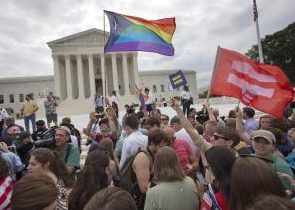
The 10-year anniversary of one of the most important Supreme Court cases in queer history, Obergefell Vs. Hodges, not only marks an anniversary, but now also an injunction attempting to overturn the legalization of queer marriage.
Davis Vs. Ermold, Kim Davis’ call upon the First Amendment’s religious liberty clause, claimed that the 14th Amendment infringed on her right to adequately express her religious beliefs, and requested the ability to refuse a marriage license to a queer couple. A day after Obergefell won in court, June 27, 2015, Davis denied a marriage license to April Miller and her partner. Miller Vs. Davis then won in court, with Davis needing to pay over $200,000 to the Miller family. The case of Davis Vs. Ermold was dismissed and queer marriage now remains legal and continues to be protected as a constitutional right of the 14th Amendment.
“Marriage is between one man and one woman,” said Kim Davis, while on the witness stand for contempt of court in 2015. Davis stated that queer marriage was “not of God.”
While her previous attempts to ban LGBTQ+ marriages fell short, Davis’ case slowly made its way up to the Supreme Court, stirring alarm regarding the legality of queer marriage.
The main defense used in the Miller Vs. Davis case as well as Davis Vs. Ermold was the religious beliefs clause in the First Amendment.
“Queer marriage ‘creates serious questions about religious liberty,” said Roberts, C.J, a lawyer for Kim Davis, and it would “threaten the religious liberty of many Americans.”
Some RHS students question the moves of Davis, building support for queer marriage.
“Why does it matter to the rest of the world?” said Paisley Swanson, 11, “it doesn’t affect those outside of the marriage.”
Queer marriage has consistently been a hot topic, but with the solidification of Obergefell Vs. Hodges, it gives a sense of security to those who are a part of or who support the LGBTQ+ community.
“You shouldn’t be able to make the decision on who someone marries because of her religious beliefs,” said Chasity Tulensa, 11. “It’s unconstitutional.”
The renewal of Obergefell Vs. Hodges solidifies the sanctity of queer marriage, despite the fact that six of the nine Supreme Court judges lean conservative, the majority of the court chose to protect the equal right to marry.