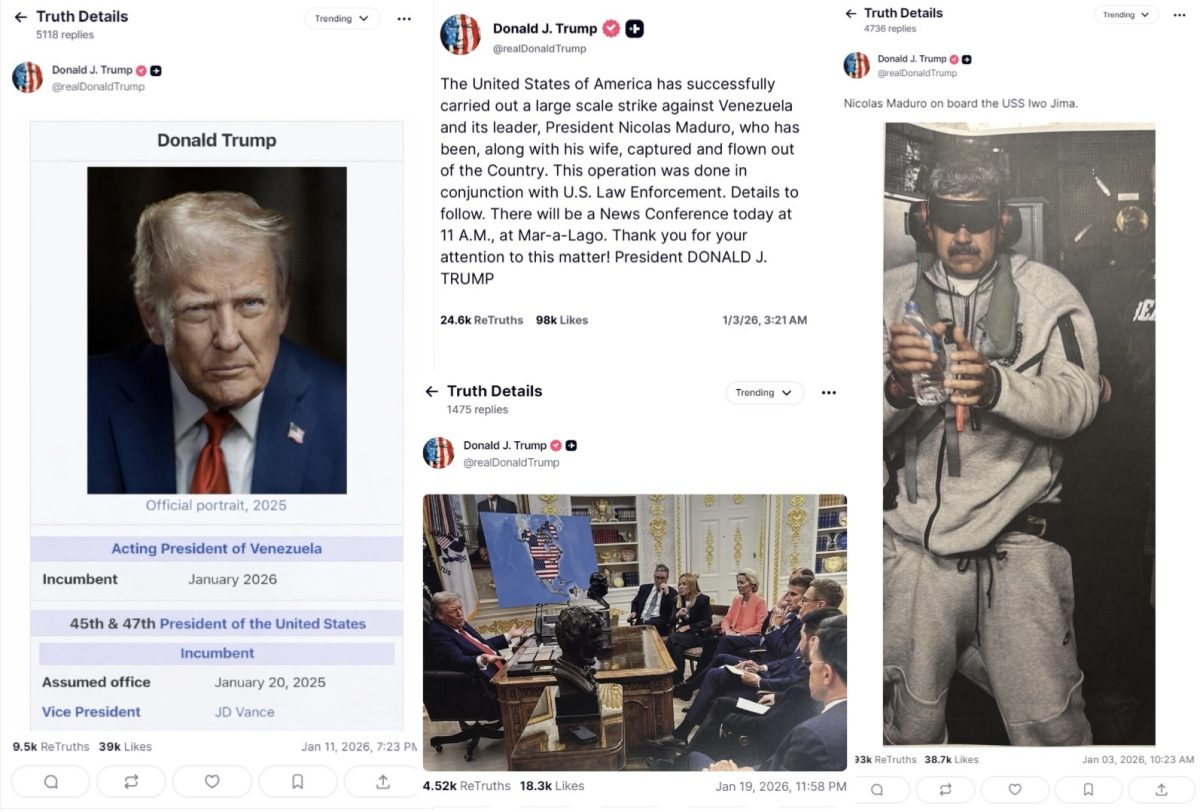
United States President, Donald Trump, announced the capture of the petrostate’s president, Nicolás Maduro, and his wife, Cilia Flores, through the military operation named “Absolute Resolve,” in the capital of Venezuela, Caracas.
The Bolivarian Republic of Venezuela has recently been under pressure from surrounding countries due to the steady growth and eventual downfall of the nation’s economy as well as society following World War II. Venezuela’s former president Hugo Chavez, who passed away in 2013, enacted numerous domestic economic policies, such as those that led to the country’s economic crash in the mid-2010s. The government spending was extremely circular in the sense that instead of saving portions of funds and income, their revenue went right back into their government. This government ran up double-digit deficits and when times got tough, they had little to no spending resources. This led the country to a quick and harsh economic undoing; all of their economic success came to a screeching halt.
“Venezuela continues to navigate complex economic and political developments which are affecting vulnerable people’s needs,” said the United Nations Office for the Coordination of Humanitarian Affairs, OCHA, in a recent article titled, “Venezuela.”
This mismanagement and extreme dependency on oil left the country unprepared and at a loss when oil prices took a nosedive in the summer of 2014. According to the Economics Observatory’s article, ”Why did Venezuela’s economy collapse?,” from 2013 to 2023, living standards in Venezuela plummeted 74%. Economic depletions like this tend to be attributed to various circumstances such as war or environmental challenges that require funding for aid. Venezuela, however, was going through neither. This economic crisis can be attributed to Venezuela’s political corruption.
“A prolonged escalation of tensions could deepen already fragile socio-economic conditions, raise protection concerns, significantly increase humanitarian needs, and disproportionately affect the most vulnerable,” according to OCHA in “Venezuela.”
Venezuela’s economic collapse left the stability of the country compromised. Studies from OCHA’s “Venezuela” article report that since 2014, 23% of the country’s population has fled the country, which is around 7.9 million people; as of December 2025, this is one of the largest displacement crises in the world. After Chavez’s death, his successor, Maduro, was inaugurated April 19, 2013; he governed for over 12 years and his term was expected to surpass that. However, instead of serving the rest of his term, Maduro, alongside his wife, was captured by the U.S. military under President Donald Trump’s direction.
“Last night and early today, at my direction, the United States armed forces conducted an extraordinary military operation in the capital of Venezuela … It was an operation against a heavily fortified military fortress in the heart of Caracas to bring outlaw dictator Nicolás Maduro to justice,” Trump said during a news conference held at his Mara-Lago residence in Florida, according to the Department of War.
Maduro was arrested on charges regarding conspiring with Colombian guerrillas to traffic cocaine into the U.S, narco-terrorism, and undermining democracy. The military arrested Maduro, with the intent to halt any drug trafficking schemes. The administration and some Americans have praised the operation as it was completed without any American deaths.
“Since his early days in Venezuelan government, Maduro Moros has tarnished every public office he has held,” the U.S. district court said in Marduo’s indictment documents. “Venezuela’s Minister of Foreign Affairs, Maduro Moros provided Venezuelan diplomatic passports to drug traffickers and facilitated diplomatic cover for planes used by money launderers to repatriate drug proceeds from Mexico to Venezuela.”
Although Trump’s administration and many of its supporters feel dignified in this military mission’s success, there are many who were against the operation from the start due to concerns with international law and uncertainty about military backlash. Many people worry about the pushback and possibility of civil conflicts; these worries stem from controversial views on Maduro’s presidency. Other U.S. politicians have stepped in to give their input on the hot-button topic, including New York City mayor, Zorhan Mamdani, who governs the city where Marduo has been detained.
“This blatant pursuit of regime change doesn’t just affect those abroad, it directly impacts New Yorkers, including tens of thousands of Venezuelans who call this city home,” Mamdani said in response to the strikes in Venezuela on the Official Website of New York City government. “Unilaterally attacking a sovereign nation is an act of war and a violation of federal and international law.”